The Scale Ladder


The Scale Ladder

The GoBollard Scale Ladder Technical Specification

Explore the operational tiers that define data flow, privacy levels, and hardware interaction across the entire ecosystem.


System Architecture

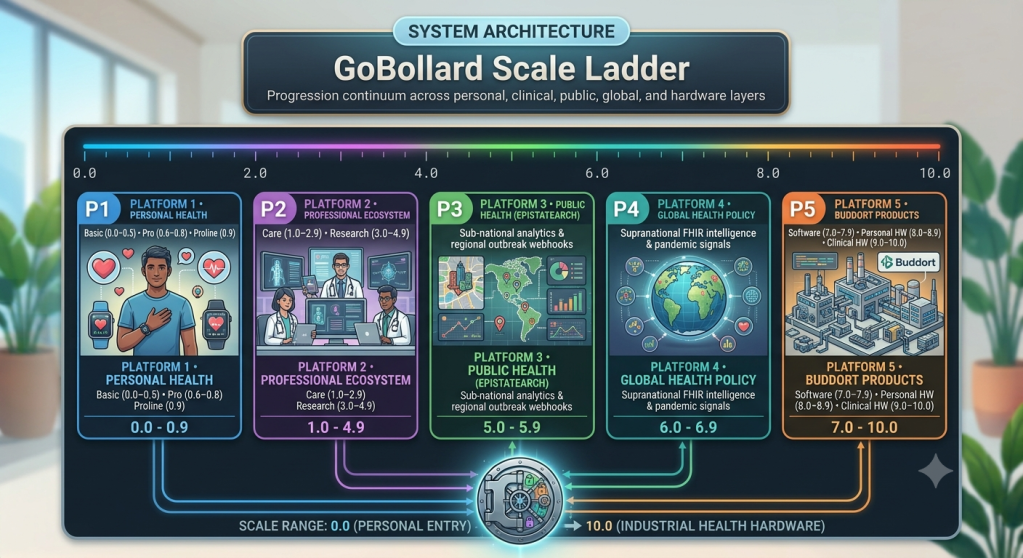
The GoBollard Scale Ladder

The GoBollard Ladder is a numerical system ranging from 0.0 to 10.0 that categorizes health services according to their complexity, data management needs, and required professional expertise.

This framework helps individuals scale their healthcare engagement based on their personal needs, health literacy, and professional qualifications.

0.0 2.0 4.0 6.0 8.0 10.0
P1
Platform 1 • Individual & Citizen Layer
Basic (0.0–0.5) • Pro (0.6–0.8) • Proline (0.9)

Governs individual personal health records, self-tracked metrics, and patient-side identity.

0.0 – 0.9
P2
Platform 2 • Provider & Clinical Layer
Care (1.0–2.9) • Research (3.0–4.9)

Encompasses institutional care workflows, electronic medical record synchronization, diagnostic documentation, and multi-site research cohorts.

1.0 – 4.9
P3
Platform 3 • Epidemiological & Public Health Layer
Sub-national analytics & regional outbreak webhooks

Enables automated, privacy-preserving webhooks and real-time data streaming for public health agencies and disease surveillance networks.

5.0 – 5.9
P4
Platform 4 • International & Regulatory Layer
Supranational FHIR intelligence & pandemic signals

Translates ground-level medical intelligence into actionable health policy frameworks and cross-border regulatory compliance protocols.

6.0 – 6.9
P5
Platform 5 • Physical Device & Sensor Layer
Software (7.0–7.9) • Personal HW (8.0–8.9) • Clinical HW (9.0–10.0)

Specifies protocols for physical integration, ranging from consumer biometric wearables (7.0) to clinical diagnostic machinery and industrial health monitoring infrastructure (10.0).

7.0 – 10.0
Scale Range: 0.0 (Personal Entry) ➔ 10.0 (Industrial Health Hardware)

Competencies, Data permissions, and Service Capabilities

Certification & Advancement

Each ladder level corresponds to specific competencies, data permissions, and service capabilities. Users progress through verification, demonstrated proficiency, and in some cases, professional certification. This ensures that sensitive health data and critical healthcare functions remain accessible only to appropriately qualified individuals and systems.

The GoBollard Ladder transforms health service delivery from fragmented applications into a coherent, scalable ecosystem where every user—from patient to global health authority—finds their appropriate place and tools.

Author

Dr. Joel Swai, MD.

The GoBollard Ladder System was developed by Dr. Joel Swai, a licensed Tanzanian physician and the Chief Researcher for the MyHealthNote Ecosystem.

With more than a decade of clinical and research experience spanning Tanzania, China, and Canada, Dr. Swai has contributed to internationally peer-reviewed publications across internal medicine, epidemiology, biostatistics, clinical research, and meta-analysis, with his work indexed in leading academic databases.

Dr. Swai is dedicated to advancing medical research in developing regions, applying his expertise to champion evidence-informed health policies supported by locally sourced and analyzed data.


The GoBollard Ladder in Action

MyHealthNote Ecosystem Integration

Unified Platform Integration & Service Tiers

Examine the multi-tiered architecture of the MyHealthNote ecosystem, detailing the integration of each platform and service level into the comprehensive GoBollard framework.

Plat 1 • Personal

Basic Tier

Ladder: 0.0 to 0.5
  1. Purpose: Comprehensive health journey tracking spanning all health states—wellness, unwell, and emergency—within a secure, unified platform.
  2. Key Capabilities: Management of vital signs and health status with automatic generation of Health Profile Insights (HPI)—a patient-centered health summary derived from your personal health logs for clinical consultations.
  3. Data Control: Full ownership of personal health data with the ability to share relevant wellness context during medical visits.
  4. Patient Benefits: Enhances health communication skills, reduces appointment stress, and provides instant access to your complete health narrative—empowering you as an active participant in your care.
Plat 1 • Personal

Pro Tier

Ladder: 0.0 to 0.8
  1. Purpose: Token-based reward system that transforms proactive health management into a collaborative, rewarding journey—turning healthy behaviors into meaningful connections and community support.
  2. Earning NilNil Tokens (0.6): Earn tokens through evidence-based health practices:
    • Master life-saving skills via VitalsGamify (up to 8 tokens per session)
    • Generate and review Health Profile Insights (HPI) reports (2 tokens)
    • Test knowledge in Symptom Recall and Library quizzes (1 token per correct answer)
  3. Spending Tokens – NilNil Center (0.6): Use NilNil tokens to:
    • Connect with peers sharing similar health conditions or skills
    • Connect with automatically recommended healthcare providers tailored to your specific health needs, filtered by real-time availability and proximity.
    • Join “Buddort” groups—safe, moderated spaces led by experts and researchers (Fodir)
    • Share skills or thrift items within your community
  4. Communication Center (0.7): Chat with friends, healthcare workers, researchers, and AI assistants to get tailored insights. Earn community contribution credits (CCC) when others save your shared information to their libraries.
  5. Treat Center (0.8): Use earned CCC to mobilize community assistance during illness periods. Higher CCC balance enables faster community response when you need help most.
  6. Benefits & Outcomes: Access to educational resources, direct communication with healthcare providers, and a virtuous health cycle strengthening individual and community well-being.
Plat 1 • Personal

Proline Tier

Ladder: 0.0 to 0.9
  • Purpose: Generate verified, professional medical documentation—from simple sick notes to detailed case studies for publication—while maintaining full control over your health information.
  • Self-Generated Reports: Maintain and access a complete record of all vital signs assessments, Health Profile Insights (HPI) reports, health status logs, and pediatric assessments you’ve generated.
  • Patient & Hospital Reports: Generate official sick notes and certificates by summarizing hospital records. Sent automatically to referencing healthcare workers for review, edit, and digital signature.
  • Research & Case Report Publications: Participate in medical research through confidential case report contributions in collaboration with healthcare providers and Fodir. Explicit consent can be revoked anytime.
  • Outbound Reports & Access Control: Manage all generated reports with granular control, including shareable URLs, QR codes, and instant URL revoking for full audit transparency.
  • Governance Interface (Scale 0.9): Read/view access is open to the public. Active participation—such as voting/commenting on proposals or submitting policy amendments—is strictl
  • Key Benefits: Secure review and sharing of medical documentation, contributing to research while preserving privacy, and complete narrative ownership.
Plat 2 • Professional

Care Tier (Verification)

Ladder: 1.0 to 1.9

Professional credential verification system for healthcare practitioners ensuring authenticated access to platform features.

Plat 2 • Professional

Care Tier (Practice)

Ladder: 2.0 to 2.9
  • Purpose: Clinical workflow optimization with integrated patient management tools, secure messaging, and real-time monitoring capabilities—streamlining healthcare delivery from intake to follow-up.
  • Previous Visits: Scrollable archive of all previous clinic and cubicle visit summaries, providing complete clinical history at your fingertips.
  • Current Visit Tools: Comprehensive cubicle workflow including Vital Signs (with auto-unit conversion & AI assessments), Physical Exams, Work-up Findings, ICD-10 Diagnosis search, Health-Round Chat, Management Plans, and Visit Summaries.
  • Clinical Images: Upload patient and clinician images (JPEG to DICOM format) with custom captions integrated into patient clinical history.
  • Appointment Management: Schedule new appointments complete with date, time, reason, and timeline integration.
  • Centralized Access: Single point access to licenses, consultations, referrals, surveillance, and documentation.
Plat 2 • Professional

Research Tier (Verification)

Ladder: 3.0 to 3.9

A credential verification system for academic and research institutions, ensuring only authenticated researchers can access scientific platform features.

Plat 2 • Professional

Research Tier (Practice)

Ladder: 4.0 to 4.9
  1. For Verified Healthcare Workers: Conduct patient-based studies using data from individuals under your care.
    • Study designs: Case reports, cross-sectional, cohort, case-control, systematic reviews, and meta-analyses.
    • Capabilities: Export anonymized datasets with automatic statistical analysis following STROBE & PRISMA guidelines.
    • Publication pipeline: Save preprints, undergo peer review, and publish in the MyHealthNote Journal (by Epistatearch).
  2. For Verified Researchers (Fodir): Conduct survey-based studies involving community members (Buddortters) to gather insights on health behaviors and determinants without clinical credential requirements.
Plat 3 • Public

Epistatearch

Ladder: 5.0 to 5.9
  1. Purpose: Utilize anonymized population data (with explicit consent) for evidence-based public health planning, policy formulation, and coordinated regional health interventions.
  2. Scope: Sub-national data analytics filtered by country, state, city, and postal code.
  3. API & Webhook: HL7® FHIR®-compliant REST API for real-time statistics with webhooks for disease outbreak alerts and epidemiological triggers.
  4. Suitable for: Ministries or Departments of Health.
Plat 4 • Global

Epistatearch

Ladder: 6.0 to 6.9
  1. Purpose: Address global health priorities, develop sustainable healthcare systems, and build resilience against pandemic and climate risks in partnership with international bodies.
  2. Scope: Supranational data analytics filtered by continent, subregion, and global population trends.
  3. API & Webhook: HL7® FHIR®-compliant REST API delivering cross-border intelligence and immediate pandemic signal webhooks.
  4. Suitable for: Global Health Authorities (WHO, PAHO, Africa CDC, etc.).
Plat 5 • Products

Buddort Software

Ladder: 7.0 to 7.9

Customized digital healthcare systems designed to meet specific institutional requirements, providing tailored solutions rather than generic implementations.

Plat 5 • Products

Buddort Hardware (Personal)

Ladder: 8.0 to 8.9

Innovative personal health monitoring devices including Buddort Watch for continuous vital sign tracking, Buddort Miles for anthropometric measurements, and intelligent weight measurement systems that synchronize seamlessly with Platform 1 for automated health data acquisition.

Plat 5 • Products

Buddort Hardware (Diagnostic & Therapeutic)

Ladder: 9.0 to 10.0

Industrial-scale medical diagnostic and therapeutic equipment that integrates (with appropriate permissions) with Platforms 1 and 2 for comprehensive healthcare delivery.

MyHealthNote Ecosystem • Structured across five interconnected platforms from personal health to global policy

Constitutional Enforcement & Institutional Oversight

Epistatearch Company Ltd.

Independent NGO • Ethics, Academic Governance & Public Health

While the GoBollard Scale Ladder (0.0 to 10.0) was originally authored by Dr. Joel Swai as an open architectural standard, its ongoing compliance, technical validation, and cryptographic enforcement are governed by Epistatearch Company Ltd.—an independent health research non-governmental organization.

“Compliance with the GoBollard Scale Ladder is not voluntary within the MyHealthNote Ecosystem. It is hardcoded into the platform’s API gateways, cryptographic validation routines, and data schemas. Epistatearch ensures that no system update or external integration can compromise patient sovereignty or clinical integrity.”

— Dr. Joel Swai, MD.


Bibliography

How to Cite This Framework

Select your preferred reference style below or download structured metadata directly into your reference manager (Zotero, Mendeley, EndNote).

APA 7th Edition
Swai, J. (2022). MyHealthNote Ecosystem & GoBollard Ladder: Multi-Tier Architectural Framework for Digital Health & Surveillance. In Epistatearch Technical Architecture Series (Version 1.0.0, 1st Edition, pp. EPI-MHN-2022-01). Joel Swai / Epistatearch Company Ltd. https://doi.org/10.5281/zenodo.21777356
IEEE
J. Swai, “MyHealthNote Ecosystem & GoBollard Ladder: Multi-Tier Architectural Framework for Digital Health & Surveillance”, Feb. 28, 2022, Joel Swai / Epistatearch Company Ltd., Edmonton, Canada. doi: 10.5281/zenodo.21777356.
Vancouver
Swai J. MyHealthNote Ecosystem & GoBollard Ladder: Multi-Tier Architectural Framework for Digital Health & Surveillance. Epistatearch Technical Architecture Series. 1st Edition. Edmonton, Canada: Joel Swai / Epistatearch Company Ltd.; 2022. p. EPI-MHN-2022-01. doi:10.5281/zenodo.21777356
BibTeX
@techreport{swai2022myhealthnote,
  author      = {Swai, Joel},
  title       = {MyHealthNote Ecosystem \& GoBollard Ladder: Multi-Tier Architectural Framework for Digital Health \& Surveillance},
  institution = {Epistatearch Company Ltd.},
  address     = {Edmonton, AB, Canada},
  year        = {2022},
  number      = {EPI-MHN-2022-01},
  doi         = {10.5281/zenodo.21777356},
  url         = {https://structure.myhealthnote.com/structure.html}
}